About me

I’m a PhD student in Matthias Kaschube’s group at the Frankfurt Institute for Advanced Studies (FIAS) and Goethe University Frankfurt, where, as part of the ARENA project, I study abstract representations in brains and artificial neural networks.
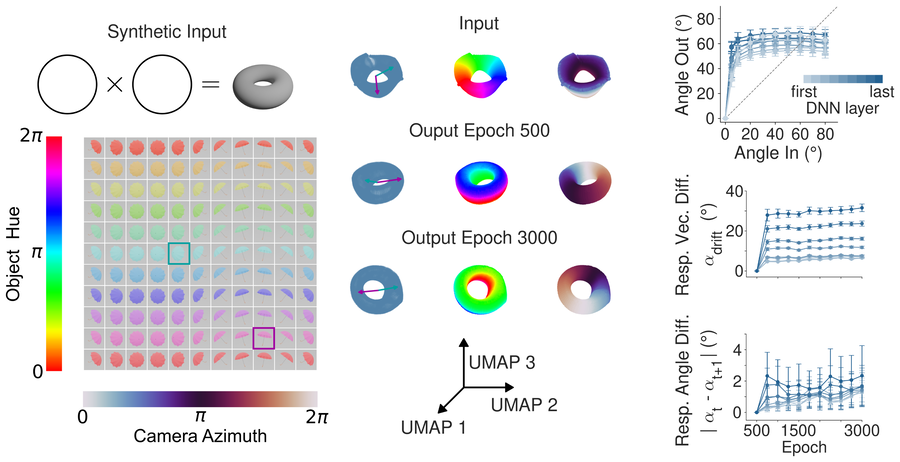
What is abstraction? To our senses, the world is never exactly the same twice. Light, viewpoint, distance and context change constantly, yet we recognize a cup as a cup, a face as the same face, a situation as one we have seen before. I’m interested in how brains find this structure: how they learn which differences matter and which can be ignored, turning a high-dimensional stream of sensory input into a small set of things they can reason about and act on. I see this ability, abstraction, as a hallmark of intelligence: treating different things as equivalent, extracting invariants such as objects, and generalizing to situations never encountered before.
To study abstraction, I use tools such as dimensionality, representational geometry and topology on brain responses evoked by natural images and on neural networks. Looking ahead, I’m excited about using virtual environments to study abstraction in brains and encoding models: rendered 3D scenes, where factors such as object identity, pose, lighting and viewpoint are known and can be varied one at a time, let us treat representations as smooth functions of these factors and analyze them with differential and information geometry.
Before my PhD, I spent two years as a deep learning engineer at Neuroelectrics, building MRI segmentation models for brain stimulation modeling, and previously worked as a research assistant on multitask learning and EEG-based brain–computer interfaces at the Universitat Politècnica de València and Universitat Pompeu Fabra. I hold a BSc in Biomedical Engineering and an MSc in Intelligent Interactive Systems from Universitat Pompeu Fabra.
News
| Nov 06, 2026 | My work Abstraction as Fisher Degeneracy: A Pullback Metric on Generative Factors has been accepted at the Machine Learning Summer School (MLSS) in Okinawa. |
|---|---|
| Jul 23, 2026 | Participated in the Barcelona Summer School for Advanced Modeling of Behavior (BAMB! 2026) in Barcelona. |
| May 21, 2026 | New preprint led by Jens-Bastian Eppler: Random Network Structure Stabilizes Neural Manifolds. |
| May 20, 2026 | New preprint: MAPS: A Synthetic Dataset for Probing Vision Models in a Controlled 3D Scene Space. |
| Mar 10, 2026 | Gave a talk, The Geometry and Topology of Abstract Representations, at the Symposium on Abstract Representations in Neural Architectures at CNS 2026 in Vancouver. |
Selected Publications
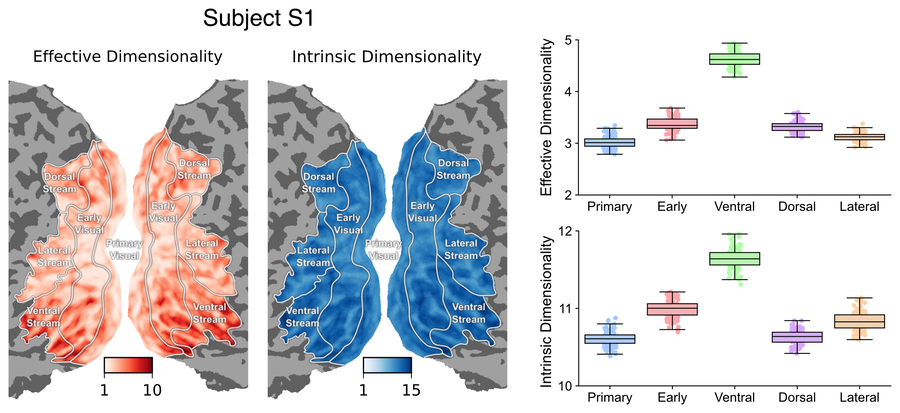
- Representations become higher-dimensional along the human visual hierarchy, but collapse in the later layers of deep vision models, limiting their semantic generalization.Advances in Neural Information Processing Systems (NeurIPS)
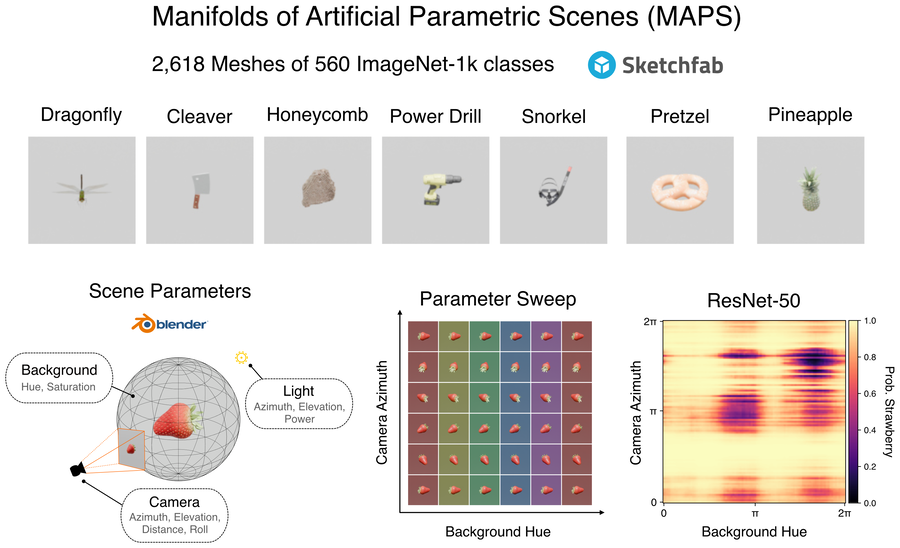
- A synthetic 3D dataset for probing what vision models represent, with full control over the scene.arXiv preprint arXiv:2605.20549
- Random connectivity keeps the similarity structure of neural representations stable, even as synapses keep changing.bioRxiv